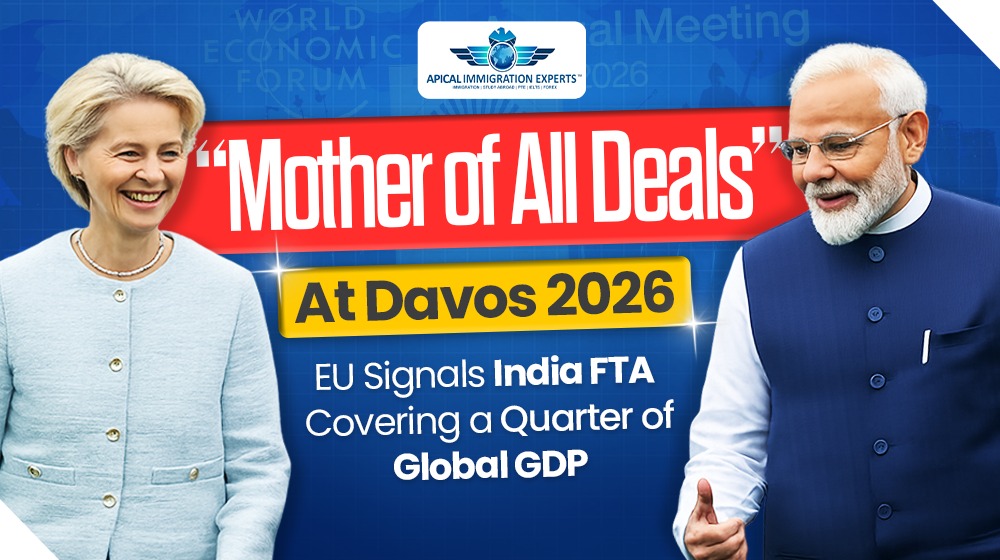
‘Mother of All Deals’: At Davos 2026, EU Signals India FTA Covering a Quarter of Global GDP
At the World Economic Forum in Davos, the European Union signalled it is near finalising a long-pending free trade agreement with India. European Commission President Ursula von der Leyen said the talks have reached a key stage. The deal could soon become a reality.
Von der Leyen described the agreement as historic. She said it could connect nearly two billion people and cover about 25% of global GDP. Many have already called it the “mother of all deals.”
Why the agreement matters
The India–EU free trade deal is important for both sides. For the EU, India is a strategic partner. The deal helps the EU reduce reliance on a few economies and strengthen its supply chains.
For India, the agreement would boost exports, attract investment, and create jobs in manufacturing, services, technology, and other sectors. It would also encourage European companies to expand operations and production in India.
Talks gain momentum
Negotiations started in 2007 but stalled for almost a decade. They resumed in 2022. Since then, discussions have moved forward alongside the India–EU Trade and Technology Council. The council focuses on technology, digital rules, and supply-chain resilience.
This parallel approach has widened the talks and addressed regulatory gaps. The discussions now go beyond tariff cuts.
Geopolitical shifts add urgency
Global changes have made the agreement more urgent. Both India and the EU want to secure their roles in reshaped supply chains.
Bilateral trade is already strong. Goods trade reached €124 billion in 2023. Services trade, led by IT and digital services, stood at about €60 billion. Officials believe the deal could further expand trade in clean energy, pharmaceuticals, advanced manufacturing, and digital services. This expansion would create new jobs on both sides.
Challenges remain
Despite optimism, several issues are unresolved. The EU wants lower tariffs on automobiles, wines, and spirits. India wants easier mobility for skilled workers, which is sensitive for the EU due to different visa and labour rules.
Other points include sustainability standards, public procurement, and regulatory alignment. Both sides will need political discussions to resolve them.
Next steps
Von der Leyen will visit India soon to help bridge the gaps. The trip comes before a scheduled India–EU leaders’ meeting. Both sides aim to show progress.
If finalised, the deal would be one of the EU’s most important trade agreements in recent years. It would strengthen economic ties, create long-term jobs, and signal strategic alignment as global trade shifts.
Follow updates on the India–EU trade agreement. Explore how businesses and professionals can benefit from new opportunities in trade, investment, and employment.
- Email: info@immigrationxperts.com
- Call us: +91-9999467686, +91-8447-696555