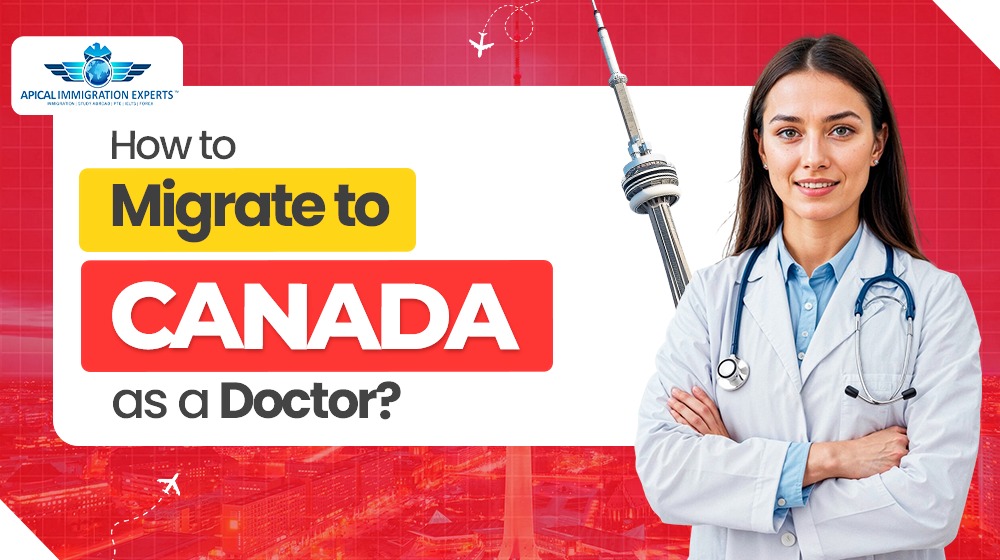
Canada has a growing shortage of medical professionals, and qualified doctors from around the world are in high demand. If you are a foreign-trained doctor looking to build your career in Canada, there are several immigration pathways available. These options also provide long-term stability and excellent professional opportunities.
This guide will show you how to migrate to Canada as a doctor, explain the main immigration pathways, and outline the step-by-step process to practice medicine legally in Canada.
Check Your Skilled Assessment & Eligibility
Can Foreign Doctors Work in Canada?
Yes. Canada welcomes internationally trained doctors through multiple programs, including:
-
Express Entry
-
Provincial Nominee Program (PNP)
-
Atlantic Immigration Program (AIP)
-
Rural Community Immigration Pilot (RCIP)
-
Francophone Community Immigration Pilot (FCIP)
To work legally as a doctor, you need to:
-
Hold a recognized medical degree
-
Get your credentials verified
-
Pass the Medical Council of Canada (MCC) exams
-
Complete postgraduate training
-
Obtain a provincial or territorial medical license
Top Immigration Pathways for Doctors
1. Canada Express Entry
Express Entry is one of the fastest ways for doctors to gain permanent residence. Doctors without Canadian work experience can also apply under this system.
Eligible candidates can qualify through:
-
Federal Skilled Worker Program (FSWP)
-
Canadian Experience Class (CEC)
Recently, Canada introduced healthcare-focused Express Entry draws that target doctors specifically.
Benefits of Express Entry:
-
No job offer required
-
Selection based on skills, education, and experience
-
Fast PR processing
-
Healthcare-focused draws
2. Canada Provincial Nominee Program (PNP)
PNP works well if you have a job offer or a provincial support letter. Provinces regularly hold draws to invite eligible doctors.
Each province reserves up to 5,000 spots annually for doctors.
Why choose PNP?
-
High demand across provinces
-
Quotas reserved for doctors
-
Faster PR with provincial nomination
3. Atlantic Immigration Program (AIP)
AIP targets Canada’s Atlantic provinces: Newfoundland and Labrador, Nova Scotia, New Brunswick, and Prince Edward Island. Doctors must have a job offer from a designated employer to qualify.
Benefits of AIP:
-
Strong demand for doctors
-
No LMIA required
-
Community and settlement support
4. Rural Community Immigration Pilot (RCIP)
RCIP offers a direct PR route for doctors willing to work in rural communities. It covers 14 designated areas across six provinces.
Requirements include:
-
A valid job offer from a designated employer
-
At least 12 months of work experience
-
English proficiency (CLB 4–6)
-
Proof of settlement funds
Why choose RCIP?
-
Faster visa processing
-
Lower competition
-
Assistance with local settlement and lifestyle
5. Francophone Community Immigration Pilot (FCIP)
FCIP is for French-speaking doctors outside Quebec. Candidates must have a job offer from a designated employer in a Francophone community.
Benefits of FCIP:
-
Direct PR pathway
-
Lower CRS score requirement
-
No LMIA needed
-
High demand for French-speaking doctors
Medical Licensing Requirements in Canada
Foreign doctors must complete licensing before practicing:
-
Verify credentials through the Medical Council of Canada (MCC)
-
Obtain a positive Educational Credential Assessment (ECA)
-
Pass the MCC Qualifying Exam (MCCQE Part I)
-
Complete postgraduate residency
-
Obtain certification from:
-
Royal College of Physicians and Surgeons of Canada (RCPSC), or
-
College of Family Physicians of Canada (CFPC)
-
Step-by-Step Process to Migrate as a Doctor
-
Earn a recognized medical degree (MBBS/MD) listed in the World Directory of Medical Schools
-
Verify credentials with MCC
-
Clear MCCQE Part I
-
Complete required residency in Canada
-
Obtain national certification (RCPSC/CFPC)
-
Apply for a provincial or territorial medical license
-
Select the most suitable immigration pathway (Express Entry, PNP, AIP, RCIP, or FCIP)
-
Prepare and submit all required documents
-
Start practicing once licensed and approved
Final Thoughts
Migrating to Canada as a doctor involves licensing and immigration steps, but the rewards are significant. You can enjoy high demand, competitive pay, global exposure, and permanent residency for you and your family.
With careful planning and expert guidance, your transition to practicing medicine in Canada can be smooth and successful.
Frequently Asked Questions
1. Can foreign doctors work in Canada without PR?
Yes, doctors can work on a temporary permit if they have a job offer and meet licensing requirements. Many later transition to PR through Express Entry or PNP.
2. Is Indian MBBS valid in Canada?
Yes, if the university is listed in the World Directory of Medical Schools. Verification by the MCC and passing exams is still required.
3. How long does it take to become a licensed doctor in Canada?
The process can take 2–5 years, depending on specialty, exam results, and residency completion.
4. Do doctors need IELTS to immigrate to Canada?
Yes, most pathways require proof of English or French proficiency. IELTS is used for English, and TEF for French.
5. Which province is best in Canada for doctors?
Ontario, British Columbia, Alberta, Nova Scotia, and Saskatchewan have high demand. Rural and Atlantic regions may offer faster immigration options.
Want to Work in Canada as a Doctor?
Get expert guidance on medical licensing, immigration pathways, and PR applications. Contact us today to start your Canada migration journey with confidence.
- Email: info@immigrationxperts.com
- Call us: +91-9999467686, +91-8447-696555